
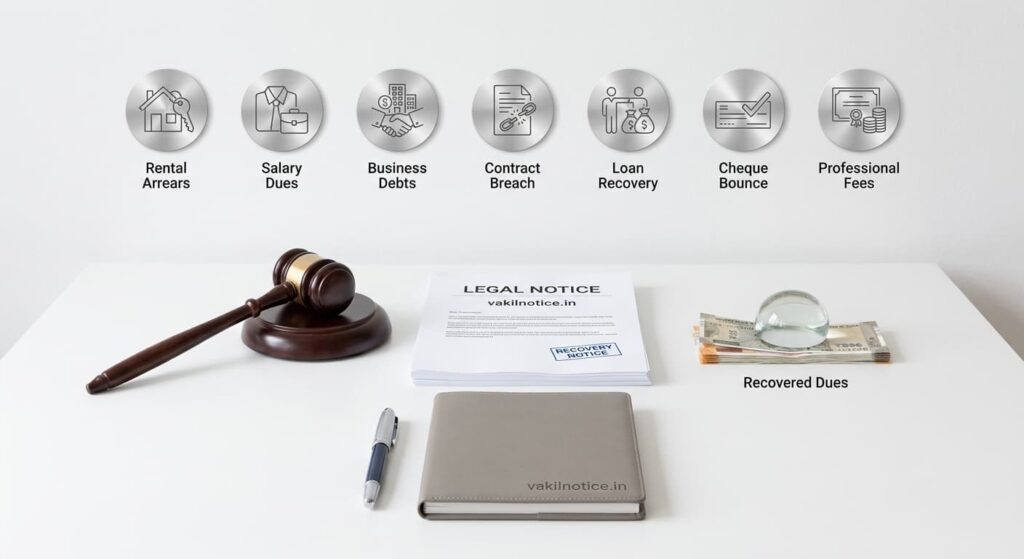
Someone owes you money. You have followed up multiple times. You have been patient. And still, nothing has changed. This is the point where most people feel stuck. Going to court feels expensive and slow. Continuing to follow up informally is getting you nowhere.
What do you do next? The answer, in most cases, is a legal notice.
A legal notice is a formal written communication sent by an advocate on your behalf. It states your claim clearly, cites the relevant law, and gives the other party a deadline to respond or pay. It is not a court filing. It is the step before one, and it is often the only step you need. In India, a large number of payment disputes get resolved at the notice stage itself. The reason is simple. When someone receives a legal notice drafted by an advocate, they understand that you are serious, you know your rights, and you are prepared to escalate. That changes the dynamic completely.
Here are seven situations where a legal notice is the right first move.
SITUATION 1: YOUR EMPLOYER IS NOT PAYING YOUR SALARY
You have worked for the month. The salary date has passed. Your employer either delays with excuses, pays partially, or stops responding to your messages entirely.
This is not just frustrating. It is illegal.
Under the Payment of Wages Act, 1936 and the Shops and Establishments Act applicable in your state, every employer is required to pay wages on time. Failure to do so gives you a clear legal ground to act.
A legal notice sent to your employer on an advocate’s official letterhead does two things. First, it puts your claim on record formally. Second, it gives the employer a deadline, usually 15 days, to clear your dues or face legal consequences. These consequences include a complaint to the Labour Commissioner or a case in the Labour Court.
Most employers settle quickly once they receive a notice, because a labour dispute is far more costly and time-consuming for them than simply paying what is owed.
When to use this: Your employer has not paid salary for one or more months, has made deductions without explanation, or has not paid full and final settlement dues after your termination or resignation.
SITUATION 2: A CHEQUE GIVEN TO YOU HAS BOUNCED
Cheque bounce is one of the most common payment disputes in India, and one of the few where the law is firmly on the receiver’s side.
Under Section 138 of the Negotiable Instruments Act, 1881, issuing a cheque that bounces due to insufficient funds is a criminal offence. The penalty can go up to two years in jail, a fine twice the cheque amount, or both.
Here is the critical part. You must send a legal notice within 30 days of receiving the cheque return memo from your bank. This is not optional. Without this notice, your legal case does not hold up in court.
The notice gives the cheque issuer 15 days to repay the amount. If they do not pay within that window, you can file a criminal complaint under Section 138 in the appropriate court.
Time-sensitive alert: The 30-day deadline starts from the date you receive the bank’s cheque return memo, not the date the cheque bounced. Do not delay.
SITUATION 3: YOUR TENANT HAS STOPPED PAYING RENT
You rented out your property in good faith. Now the tenant is not paying rent for one month, two months, or more. They ignore your calls, give excuses, or simply refuse to engage. Meanwhile, you are losing money on a property you own.
A legal notice to the tenant serves two purposes at once. It demands payment of the overdue rent and formally initiates the process of eviction if the tenant continues to default.
Under the Transfer of Property Act and state-specific Rent Control Acts, a landlord has the right to recover unpaid rent and, in many cases, to terminate the tenancy for non-payment. A properly drafted legal notice is the required first step before any eviction proceedings can begin in court.
Many tenants, on receiving a notice from an advocate, either clear the dues or vacate voluntarily. This saves you months of legal proceedings.
When to use this: Your tenant has not paid rent for one or more months, or has denied paying and vacating despite repeated requests.
SITUATION 4: A CLIENT IS NOT PAYING FOR YOUR WORK
You completed the project. Delivered on time. Sent the invoice. And then silence. The client reads your messages, keeps promising payment, and does nothing.
This situation is very common among freelancers, contractors, consultants, and small business owners across India.
When a payment is owed for services rendered or goods delivered, the unpaid amount is a breach of contract. If you have any written proof, a work agreement, email confirmation, invoice, WhatsApp chat, or even a purchase order, you have a valid legal claim.
A legal notice under the Indian Contract Act, 1872 formally demands the payment with a deadline. It also makes clear that failure to pay will result in a civil suit for recovery of dues, which includes the original amount plus interest and legal costs.
For clients who have been avoiding you informally, a notice on an advocate’s letterhead is often the first communication that gets an actual response.
What you need: Any written record of the work agreement or payment commitment, such as an email, WhatsApp message, invoice, or contract, is enough to proceed with a legal notice.
WHY PEOPLE ACROSS INDIA TRUST VAKIL NOTICE
Sending a legal notice sounds complicated. Finding an advocate, explaining your case, getting the notice drafted correctly, and then making sure it is delivered with proper proof. Most people do not know where to start. Vakil Notice was built to make this process simple, fast, and fully online. You do not need to visit a court or a lawyer’s office. You share your case details through WhatsApp or the contact form on the website, and the legal team handles everything from there. The notices are drafted by experienced advocates with between 5 and 38 years of practice across civil, criminal, consumer, and family law matters. Every notice is customized to your specific situation, not a generic template. It is sent through Speed Post with full tracking, and you receive the dispatch proof and receipt.
More than 13,000 clients across India have used Vakil Notice to recover unpaid dues, resolve disputes, and protect their legal rights. The service is available in Hindi, English, and other Indian regional languages, and the all-inclusive cost starts at just Rs. 1,499 with no hidden charges. If you are in any of the situations described in this article, the next step is simple. Contact the Vakil Notice team, share your case, and get your legal notice drafted and sent within 24 hours.
Visit vakilnotice.in or reach out via WhatsApp to get started.
SITUATION 5: A FRIEND OR RELATIVE BORROWED MONEY AND WILL NOT RETURN IT
This is one of the most emotionally difficult situations to handle. You lent money to someone you trusted, a friend, a cousin, or a colleague. Now they avoid the topic, make endless excuses, or have simply gone quiet.
Personal loans between individuals are legally valid in India, especially if there is any written evidence. A promissory note, a signed paper, a bank transfer record, or even a message where the borrower acknowledged the debt are all valid.
A legal notice in this situation does something important. It separates the personal relationship from the legal claim. It formally demands repayment with a deadline and signals that you are no longer treating this as a personal matter. This often prompts a response that you cannot get through informal conversations.
If the borrower still refuses to pay, the notice creates a paper trail you can use to file a money recovery suit in civil court.
Even without a written agreement: Bank transfer records, UPI payment screenshots, or WhatsApp messages where the borrower acknowledges the debt can be sufficient grounds for a legal notice.
SITUATION 6: A BUILDER IS HOLDING YOUR BOOKING AMOUNT
You paid a booking amount or advance for a flat or plot. The project got delayed, you decided not to proceed, or the builder cancelled. Now they are refusing to refund your money, or they keep promising a refund that never arrives.
Builders and real estate developers are bound by the Real Estate Regulation and Development Act, 2016, commonly known as RERA, as well as general consumer protection laws. Retaining your booking amount without valid reason is a violation, and you have strong legal recourse.
A legal notice to the builder formally demands the refund and puts them on notice that you are aware of your rights under RERA and the Consumer Protection Act, 2019. Builders typically respond to these notices because a RERA complaint or consumer forum case carries penalties, compensation orders, and significant reputational damage.
Key documents to have ready: Payment receipts, the booking agreement, and any written communication from the builder about the project or the promised refund will strengthen your notice significantly.
SITUATION 7: AN ONLINE PLATFORM REFUSED YOUR REFUND
You ordered a product online. It arrived damaged, or it never arrived at all. You raised a complaint. The platform rejected your claim, gave you a runaround, or simply closed the ticket without resolution. Now you are stuck with a loss and no clear path forward.
Under the Consumer Protection Act, 2019, every consumer in India has the right to a refund, replacement, or compensation for defective goods or deficient services. E-commerce platforms are explicitly covered under this law.
A legal notice to the platform, sent formally through an advocate, carries far more weight than a customer service complaint. It signals that you intend to take this to the Consumer Disputes Redressal Commission if they do not resolve it. Most platforms, when they receive a proper legal notice, escalate the complaint internally and resolve it to avoid a consumer forum case.
This also applies to: Insurance claim rejections, bank disputes, telecom billing issues, and any service where you paid but did not receive what was promised.
WHEN SHOULD YOU SEND A LEGAL NOTICE?
The right time to send a legal notice is before you assume it is too late and before the situation becomes more complicated.
A notice does not burn bridges. It opens a formal channel for resolution. Most disputes in India settle at the notice stage itself, without any court involvement.
What matters is that the notice is drafted correctly, with the right legal provisions cited, the right deadline set, and the right tone maintained. A notice that is vague, emotionally worded, or legally incorrect can actually weaken your position.
This is why having an experienced advocate draft your notice is not just helpful. It is what makes the notice work.
If you are dealing with any of the situations described above, do not wait. The longer you delay, the harder recovery becomes. Contact Vakil Notice today, share your case, and get a professionally drafted legal notice sent anywhere in India within 24 hours.
Visit vakilnotice.in or fill out the contact form to get started.
FREQUENTLY ASKED QUESTIONS
Q: Is a legal notice legally binding in India?
A legal notice itself is not a court order, but it is a formal legal document that creates a record of your claim. If the other party ignores it, you can use it as evidence when filing a case in court.
Q: How much does it cost to send a legal notice in India?
At Vakil Notice, you can get a professionally drafted and delivered legal notice for Rs. 1,499 all inclusive with no hidden charges. You pay Rs. 399 upfront to start, and Rs. 1,100 after the notice is drafted and approved by you.
Q: What happens if the other party ignores the legal notice?
If the opposite party does not respond within the stated deadline, you can proceed with filing a case in the appropriate court or forum. The legal notice itself becomes a key piece of evidence that shows you attempted resolution before escalating.
Q: Can I send a legal notice without a lawyer?
You can write one yourself, but a notice drafted by an advocate carries significantly more legal weight and is taken more seriously by the receiving party. It also ensures the correct legal provisions are cited for your specific situation.
Q: How long does it take to send a legal notice through Vakil Notice?
In most cases, your legal notice is drafted, reviewed by you, approved, and dispatched within 24 hours of receiving your complete details and documents.