
A cheque bounce can create serious financial and legal problems for both the person who issued the cheque and the person who received it. In India, cheque dishonour for certain legally enforceable debts or liabilities can lead to proceedings under Section 138 of the Negotiable Instruments Act, 1881.
The law provides a specific process for sending a legal notice, allowing the drawer an opportunity to make payment, and taking further legal action if the payment is not made within the prescribed period.
This guide explains cheque bounce law in India, Section 138, the cheque bounce legal notice time limit, punishment, the legal process, settlement, and other important issues.
Table of Contents
ToggleWhat Is a Cheque Bounce?
A cheque bounce occurs when a bank does not honour a cheque presented for payment. The bank may return the cheque unpaid for several reasons, such as insufficient funds, a closed account, a stop-payment instruction, or other banking issues.
When the statutory requirements are satisfied, dishonour of a cheque issued towards a legally enforceable debt or liability may attract Section 138 of the Negotiable Instruments Act.
What Is a Cheque Return Memo?
When a bank returns a cheque unpaid, it generally provides a cheque return memo stating the reason for dishonour.
The return memo is an important document because it records the bank’s reason for returning the cheque. The payee should keep the original cheque, return memo, and other documents relating to the transaction.
What Are the Common Reasons for Cheque Bounce?
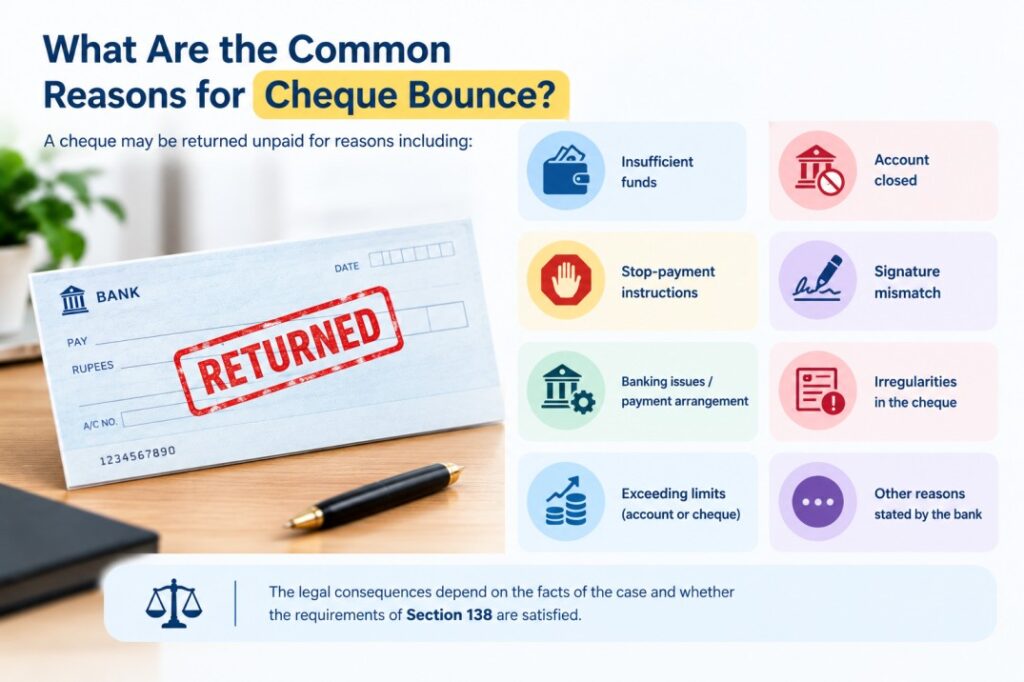
A cheque may be returned unpaid for reasons including:
- Insufficient funds in the account
- Account closed
- Stop-payment instructions
- Signature mismatch
- Payment arrangement or banking issues
- Irregularities in the cheque
- Exceeding an applicable account or cheque limit
- Other reasons stated by the bank
The legal consequences depend on the facts of the case and whether the requirements of Section 138 are satisfied.
What Is Section 138 of the Negotiable Instruments Act?
Section 138 deals with the dishonour of a cheque for insufficiency of funds or where the amount exceeds the arrangement made with the bank, subject to the conditions prescribed by law.
For Section 138 to apply, the cheque must generally have been issued for the discharge, wholly or partly, of a legally enforceable debt or other liability.
When Does Section 138 Apply?
The main statutory requirements include:
- A cheque is drawn by the accused on an account maintained by them.
- The cheque is issued towards a legally enforceable debt or other liability.
- The cheque is presented within its applicable validity period.
- The bank returns the cheque unpaid for a reason covered by Section 138.
- The payee or holder in due course sends a written demand notice within the prescribed period after receiving information from the bank about the dishonour.
- The drawer fails to make the required payment within 15 days of receiving the notice.
If these requirements are satisfied, the payee may take further legal action in accordance with the Act.
When May Section 138 Not Apply?
Not every dishonoured cheque automatically results in liability under Section 138.
The statutory requirements must be satisfied. For example, issues concerning the existence of a legally enforceable debt, presentation of the cheque, statutory notice, limitation, and other facts can affect a case.
Because cheque bounce matters are fact-specific, legal advice may be appropriate before starting proceedings.
What Should You Do Immediately After a Cheque Bounces?
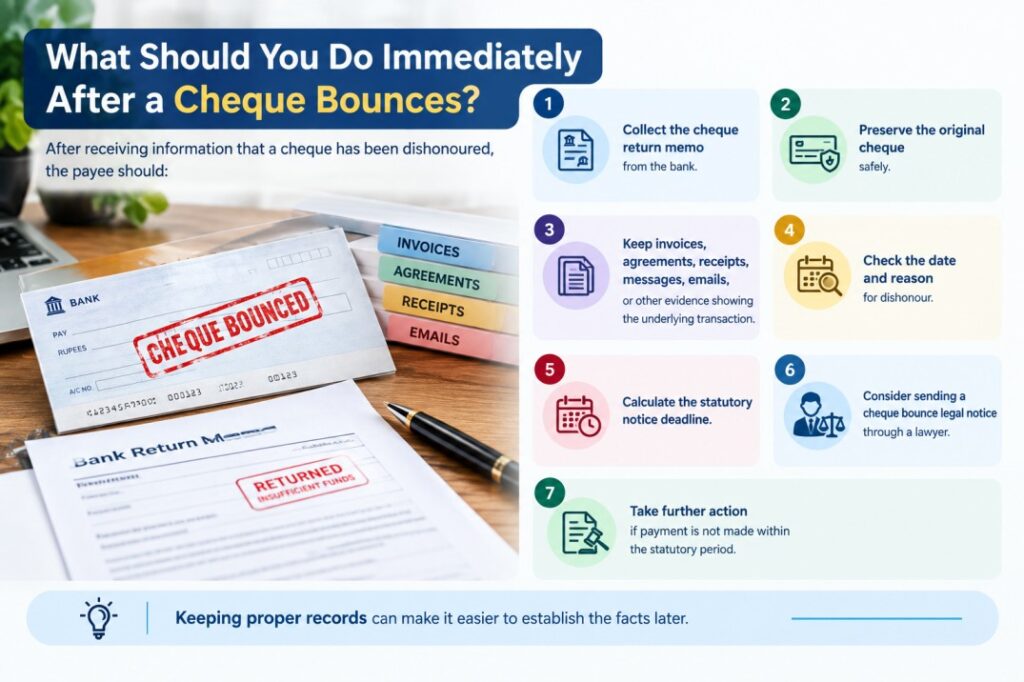
After receiving information that a cheque has been dishonoured, the payee should:
- Collect the cheque return memo from the bank.
- Preserve the original cheque safely.
- Keep invoices, agreements, receipts, messages, emails, or other evidence showing the underlying transaction.
- Check the date and reason for dishonour.
- Calculate the statutory notice deadline.
- Consider sending a cheque bounce legal notice through a lawyer.
- Take further action if payment is not made within the statutory period.
Keeping proper records can make it easier to establish the facts later.
What Is a Cheque Bounce Legal Notice?
A cheque bounce legal notice is a formal written demand sent to the drawer after dishonour of a cheque.
The notice informs the drawer about the dishonoured cheque and demands payment of the cheque amount within the period prescribed under Section 138.
A properly prepared notice should accurately describe the transaction and comply with the applicable legal requirements.
What Should a Cheque Bounce Notice Contain?
A cheque bounce notice generally includes:
- Details of the person issuing the cheque
- Details of the payee
- Cheque number and date
- Cheque amount
- Bank and account details where relevant
- Date of presentation
- Reason for dishonour
- Details of the underlying debt or liability
- Demand for payment
- Applicable statutory requirements
- Consequences of failing to make payment
The notice should be prepared carefully because errors in the notice can create unnecessary legal issues.
Cheque Bounce Legal Notice Format
A cheque bounce notice should be based on the actual transaction and documents available in the matter. There is no single format that can safely be copied for every case.
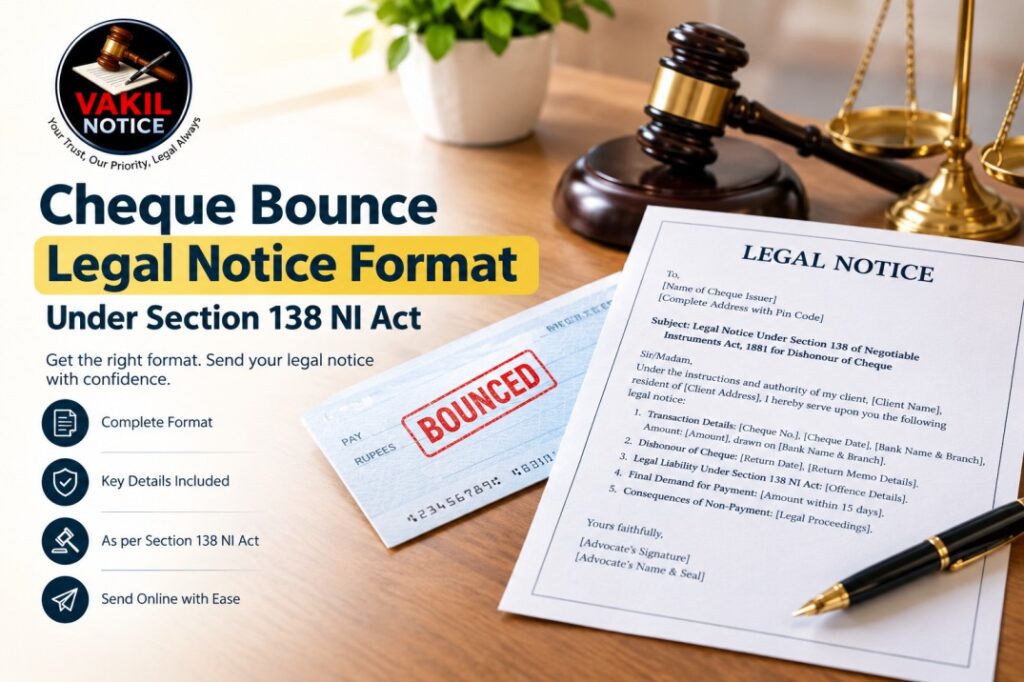
If you want to understand the structure and important contents of such a notice, see our Cheque Bounce Legal Notice Format Under Section 138 NI Act.
What Is the Time Limit for Sending a Cheque Bounce Notice?
Under Section 138, the payee or holder in due course must issue the written demand notice within 30 days of receiving information from the bank regarding the dishonour of the cheque.
After receiving the notice, the drawer gets 15 days to make the required payment.
These statutory timelines are important. Missing a limitation requirement can affect the ability to proceed with a complaint.
What Happens After a Cheque Bounce Notice Is Sent?
There are generally two possibilities.
The Drawer Makes Payment
If the drawer makes the required payment within the statutory period, the immediate Section 138 cause of action may not continue in the same manner.
The parties should maintain proper proof of payment and any settlement reached.
The Drawer Does Not Make Payment
If the drawer does not make the required payment within the statutory period, the payee may consider filing a complaint under Section 138, subject to the applicable limitation and other legal requirements.
Complete Cheque Bounce Legal Process in India
The process can generally be understood in the following stages:
Step 1: Cheque Is Presented
The payee presents the cheque for payment through the bank.
Step 2: Cheque Is Dishonoured
The bank returns the cheque unpaid and provides information about the reason for dishonour.
Step 3: Legal Notice Is Sent
The payee sends a written demand notice within the statutory period.
Step 4: 15-Day Payment Period
The drawer gets 15 days from receipt of the notice to make the required payment.
Step 5: Complaint May Be Filed
If payment is not made within the statutory period, the payee may file a complaint under Section 138, subject to the applicable limitation period and procedural requirements.
Step 6: Court Proceedings
The court considers the complaint and proceeds according to the applicable criminal procedure and the Negotiable Instruments Act.
Step 7: Evidence and Trial
The parties may present documents and evidence supporting their respective positions.
Step 8: Judgment and Further Proceedings
The court may pass an appropriate order based on the evidence and applicable law. Further legal remedies may be available depending on the outcome.
Where Can a Cheque Bounce Case Be Filed?
Jurisdiction in cheque bounce matters is governed by the applicable provisions of the Negotiable Instruments Act and relevant judicial decisions.
The appropriate court can depend on factors such as the bank branch where the cheque was deposited for collection and the circumstances of the transaction.
Because jurisdiction can be technical, the correct court should be confirmed based on the specific facts before filing.
What Is the Punishment for Cheque Bounce Under Section 138?
If a person is convicted under Section 138, the punishment can include:
- Imprisonment for a term that may extend to two years
- Fine that may extend to twice the amount of the cheque
- Or both
Imprisonment is not automatic merely because a cheque has bounced. A Section 138 prosecution must satisfy the statutory requirements, and the court decides the matter based on the evidence.
What Happens With a Security Cheque?
A cheque described as a security cheque does not automatically determine the outcome of a Section 138 case.
The important question can include whether a legally enforceable debt or liability existed when the cheque was presented and whether the other statutory requirements were satisfied.
The facts of the transaction and the purpose for which the cheque was issued are therefore important.
What If the Cheque Was Stopped by the Drawer?
A stop-payment instruction does not by itself prevent Section 138 proceedings.
The legal consequences depend on the facts and whether the requirements of Section 138 are satisfied, including the existence of a legally enforceable debt or liability.
What If the Bank Account Was Closed?
If a cheque is returned because the account has been closed, the payee may still have a remedy under Section 138, provided the statutory requirements are satisfied.
The bank return memo and other transaction documents should be preserved.
What If Multiple Cheques Bounce?
If several cheques relating to the same or different transactions are dishonoured, each cheque and its surrounding facts should be examined separately.
The notice and any subsequent complaint should accurately identify the relevant cheques, amounts, transactions, and dates.
What Happens When a Company Issues a Cheque?
Section 141 of the Negotiable Instruments Act deals with offences by companies.
Where a company commits an offence under Section 138, persons who were responsible for and in charge of the conduct of the company’s business may, subject to the statutory requirements, also face liability.
Being a director or officer alone does not necessarily establish liability. The specific role and facts must be considered.
Can a Cheque Bounce Case Be Settled?
Yes. Cheque bounce offences under the Negotiable Instruments Act can be compounded under Section 147.
Parties may reach a settlement during the proceedings, subject to the applicable legal procedure and the court’s role where required.
A written settlement and proof of payment should be maintained.
What Is Interim Compensation Under Section 143A?
Section 143A allows the court, subject to its statutory conditions, to order the drawer to pay interim compensation to the complainant in certain cheque dishonour cases.
The provision is not the same as a final judgment and should not be treated as an automatic payment in every case.
What Is the 20% Deposit Under Section 148?
Section 148 provides for a deposit of a minimum of 20% of the fine or compensation awarded by the trial court in certain appeals against conviction under Section 138, subject to the provisions of the section and the court’s orders.
This provision generally becomes relevant at the appellate stage after conviction, not at the beginning of every cheque bounce case.
How Long Does a Cheque Bounce Case Take?
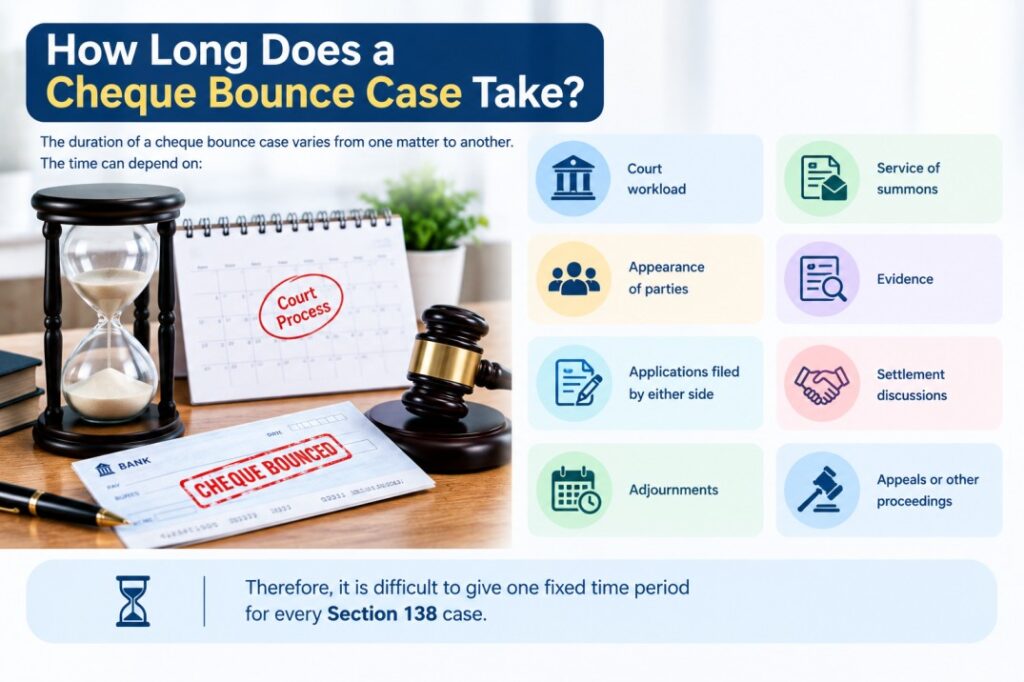
The duration of a cheque bounce case varies from one matter to another.
The time can depend on:
- Court workload
- Service of summons
- Appearance of parties
- Evidence
- Applications filed by either side
- Settlement discussions
- Adjournments
- Appeals or other proceedings
Therefore, it is difficult to give one fixed time period for every Section 138 case.
What If You Receive a Cheque Bounce Legal Notice?
If you receive a cheque bounce notice, do not ignore it.
First, review the cheque, transaction, bank return memo, and the allegations made in the notice. If you believe the demand is incorrect, disputed, already paid, or based on facts that need clarification, you should consider obtaining legal advice and sending an appropriate reply within the relevant period.
A reply should address the actual facts rather than making unsupported allegations.
Can Another Person Be Added During a Criminal Case?
In certain circumstances, a court can proceed against a person who was not originally made an accused if evidence during the inquiry or trial indicates that the person appears to have committed an offence for which they could be tried together with the existing accused.
This procedural power is currently addressed under Section 358 of the Bharatiya Nagarik Suraksha Sanhita, 2023 (BNSS).
Whether such a provision applies depends on the evidence and circumstances of the particular case.
Important Supreme Court Judgments on Cheque Bounce Cases
Several Supreme Court judgments have influenced the interpretation and procedure relating to cheque dishonour cases.
Rangappa v. Sri Mohan (2010)
The Supreme Court discussed the presumption under Section 139 of the Negotiable Instruments Act and the burden involved in rebutting that presumption.
M.S.R. Leathers v. S. Palaniappan (2013)
The Supreme Court considered issues relating to the presentation and re-presentation of cheques and the cause of action under Section 138.
Bridgestone India Pvt. Ltd. v. Inderpal Singh (2016)
The judgment is important in understanding territorial jurisdiction in cheque dishonour cases after the statutory changes concerning the place of filing.
Hardeep Singh v. State of Punjab (2014)
This judgment concerns the broader procedural principle relating to adding persons as accused during criminal proceedings. It is not limited specifically to cheque bounce cases but can be relevant when understanding the court’s power to proceed against additional persons based on evidence.
What Documents Should You Keep for a Cheque Bounce Case?
Keep copies of all documents connected with the transaction, including:
- Original cheque
- Cheque return memo
- Bank records
- Invoice or agreement
- Loan or payment records
- Receipts
- Account statements
- Emails and messages
- Legal notice
- Proof of sending the notice
- Proof of delivery
- Reply received from the drawer
- Settlement or payment records
Good documentation can be important when establishing the underlying transaction and the statutory timeline.
Are There Cheque Bounce Bank Charges?
Banks may impose cheque return charges depending on their applicable terms and policies.
These charges are separate from the legal consequences that may arise under Section 138. The exact amount can vary between banks and account types.
Can You Recover Money Through a Separate Civil Case?
A cheque bounce proceeding and a civil money recovery proceeding are legally distinct remedies.
Depending on the facts, a person may have additional remedies for recovery of money. Whether another proceeding is appropriate depends on the transaction, documents, limitation, and other circumstances.
A lawyer can help determine the appropriate legal options.
When Should You Consult a Lawyer for a Cheque Bounce?
Consider consulting a lawyer when:
- A large amount is involved
- You have received a Section 138 notice
- The underlying debt is disputed
- Multiple cheques are involved
- A company or several individuals are involved
- The cheque was issued as security
- You need to file a complaint
- You want to negotiate a settlement
- You are unsure about limitation or jurisdiction
Legal notice and limitation requirements can be technical, so professional advice can help reduce avoidable mistakes.
Frequently Asked Questions About Cheque Bounce
What is Section 138 of the NI Act?
Section 138 deals with the dishonour of certain cheques issued towards a legally enforceable debt or other liability, subject to the statutory conditions.
How many days do I have to send a cheque bounce notice?
The written demand notice must generally be sent within 30 days of receiving information from the bank about the dishonour.
How many days does the drawer get after receiving the notice?
The drawer gets 15 days from receipt of the notice to make the required payment.
What is the maximum punishment for cheque bounce?
A conviction under Section 138 can result in imprisonment of up to two years, a fine of up to twice the cheque amount, or both.
Is cheque bounce a criminal offence?
Dishonour falling within Section 138 can result in a criminal prosecution, provided the statutory requirements are satisfied.
Can a security cheque lead to a cheque bounce case?
It can, depending on the facts. Calling a cheque a security cheque does not by itself decide whether Section 138 applies.
Can a cheque bounce case be settled?
Yes. Section 147 allows offences under the Negotiable Instruments Act to be compounded, subject to the applicable procedure.
What happens if the accused does not pay after receiving the legal notice?
If the statutory payment is not made within 15 days of receipt of the notice, the payee may consider filing a complaint under Section 138 within the applicable limitation period.
Can I send a legal notice online?
Yes, a legal notice can be prepared and sent through an online legal notice service, provided the process and applicable legal requirements are properly followed.
Need Help With a Cheque Bounce Legal Notice?
If you need help preparing and sending a cheque bounce legal notice, Vakil Notice provides online legal notice drafting and sending services. You can get a legal notice prepared with the relevant cheque and transaction details and send it online.
Contact Vakil Notice today to get started with your legal notice.
Conclusion
A cheque bounce can become a serious legal matter when the requirements of Section 138 of the Negotiable Instruments Act are satisfied. The process includes the cheque’s dishonour, a statutory demand notice, a 15-day payment opportunity, and possible court proceedings if payment is not made.
The most important steps are to preserve the relevant documents, follow the statutory timelines, prepare the notice carefully, and understand the facts of the underlying transaction.
Because cheque bounce law involves specific statutory and procedural requirements, professional legal advice should be considered where the matter is disputed or significant.
Disclaimer: This article is provided for general informational purposes only and does not constitute legal advice. Laws and court interpretations may change, and the outcome of a cheque bounce matter depends on its specific facts. Consult a qualified lawyer for advice about your particular case.