
An Agreement to Sell creates important obligations between a buyer and seller. But problems can arise when the buyer has paid an advance amount and the seller refuses to execute the sale deed, delays the registration, or does not return the money.
This situation can leave the buyer unsure about what to do next. Many people also believe that they have to wait for three years before taking legal action.
That is not necessarily the case. The limitation period and the appropriate legal remedy depend on the terms of the agreement, the date fixed for performance, and when the seller refuses to perform the agreement.
This guide explains what a buyer can do when an agreement to sell is breached in India, including legal notice, specific performance, recovery of money, injunctions, limitation and other possible remedies.
Table of Contents
ToggleWhat to Do If the Seller Does Not Execute the Sale Deed or Return the Money?
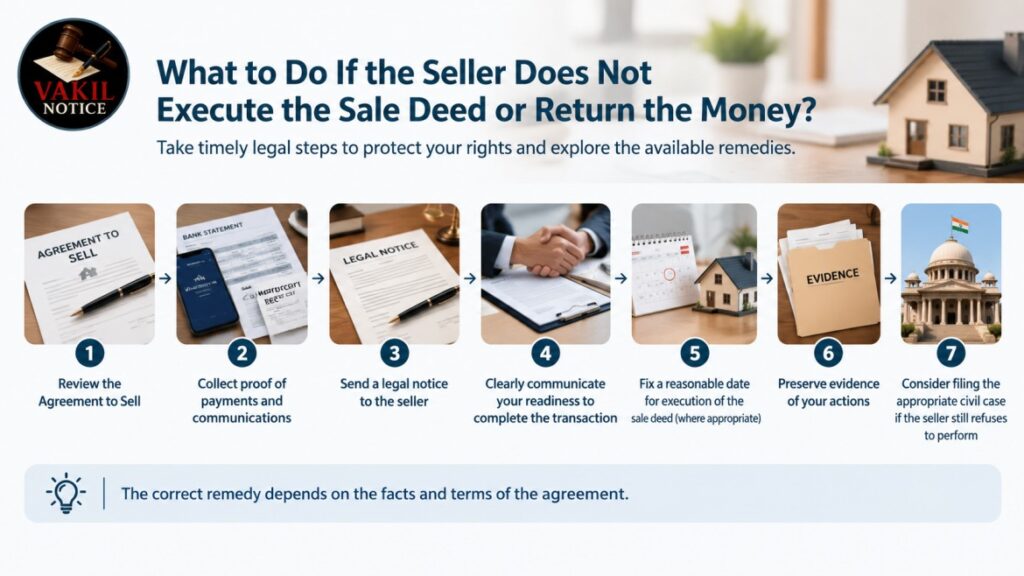
If you have entered into an agreement to sell and the seller is neither completing the registration nor returning your money, you should take timely legal steps.
The usual course may include:
- Review the Agreement to Sell.
- Collect proof of payments and communications.
- Send a legal notice to the seller.
- Clearly communicate your readiness to complete the transaction.
- Fix a reasonable date for execution of the sale deed where appropriate.
- Preserve evidence of your actions.
- Consider filing the appropriate civil case if the seller still refuses to perform.
The correct remedy depends on the facts and terms of the agreement.
Quick Steps After a Breach of Agreement to Sell
- Keep the original Agreement to Sell safely.
- Collect bank statements and payment receipts.
- Preserve WhatsApp messages, emails and other communications.
- Send a properly drafted legal notice.
- Record your readiness and willingness to perform your part.
- Consult an advocate about specific performance, recovery or injunction proceedings.
What Is a Breach of an Agreement to Sell?
A breach of an Agreement to Sell generally occurs when one party fails or refuses to perform an obligation required under the agreement.
For example, a seller may breach the agreement by refusing to execute the sale deed after receiving advance money, subject to the terms of the agreement and the circumstances of the transaction.
Common Examples of Breach of an Agreement to Sell
A dispute may arise when:
- The buyer has paid advance money but the seller does not complete the sale.
- The seller refuses to execute the sale deed.
- The seller does not return the advance amount after refusing to proceed.
- The seller repeatedly delays registration without a valid reason.
- The seller attempts to sell the property to another person.
- The seller disputes the terms of the original agreement.
- The seller claims that the payment was a loan rather than sale consideration.
The legal remedy will depend on the documents, evidence and facts of the individual case.
What to Do If Registry Is Not Done After an Agreement to Sell?

If the seller does not complete the registration as agreed, the buyer should avoid relying only on verbal discussions.
The first step is generally to examine the Agreement to Sell and determine what obligations were agreed upon, including the payment schedule, date of execution and conditions for registration.
Send a Legal Notice to the Seller
A legal notice can formally communicate that the buyer expects the seller to perform the obligations under the Agreement to Sell.
The notice should generally identify the agreement, payments made, the obligations that remain pending and the action expected from the seller.
Where appropriate, it should also clearly record that the buyer remains ready and willing to perform their part of the agreement.
Fix a Date for Execution of the Sale Deed
Depending on the terms of the agreement and the circumstances, the buyer may specify a reasonable date and place for completing the transaction.
The purpose is to create a clear record of the buyer’s willingness to complete the transaction rather than simply waiting indefinitely.
Appear Before the Sub-Registrar Office
Where appropriate, the buyer may appear before the concerned Sub-Registrar on the agreed or notified date with the necessary documents and funds.
If the seller does not appear, the buyer should preserve whatever official or documentary evidence is available regarding their appearance and readiness.
Preserve Evidence of Your Readiness
Evidence can become important if the dispute reaches court.
Depending on the circumstances, this may include:
- Bank statements
- Payment records
- Communication with the seller
- Legal notice and delivery proof
- Documents relating to the Sub-Registrar visit
- Other evidence showing readiness to complete the transaction
Why Is “Ready and Willing” Important in a Specific Performance Case?

In a suit for specific performance, the buyer may need to establish that they were ready and willing to perform their contractual obligations.
This does not simply mean saying that you wanted the property. The surrounding facts and evidence may be important in showing your conduct and ability to perform the agreement.
How Can a Buyer Prove Readiness and Willingness?
Depending on the case, evidence may include:
- Proof of available funds
- Bank statements
- Payment records
- Previous payments made under the agreement
- Communication with the seller
- Attendance at the agreed place or office
- Legal notice showing willingness to complete the transaction
The exact evidence required depends on the facts of the case.
What Is the Limitation Period for an Agreement to Sell Dispute?
Limitation is one of the most important issues in a specific performance case.
Under Article 54 of the Limitation Act, 1963, a suit for specific performance generally has a limitation period of three years. The starting point depends on the circumstances.
If a Date Is Fixed for Performance
Where the agreement fixes a date for performance, the limitation calculation generally runs from that date.
However, the exact application of limitation depends on the terms of the agreement and the facts of the dispute.
If No Date Is Fixed for Performance
Where no specific date is fixed, Article 54 generally refers to the date when the plaintiff has notice that performance is refused.
This makes the date and evidence of refusal particularly important.
Does the 3-Year Limitation Period Mean You Should Wait for 3 Years?
No.
A three-year limitation period does not mean that a buyer should simply wait for three years before taking action.
If the seller has clearly refused to perform the agreement, delaying legal action can create unnecessary complications and may affect the buyer’s position.
It is therefore advisable to obtain legal advice as soon as a serious dispute or refusal arises.
What Happens When the Seller Clearly Refuses to Complete the Sale?
A clear refusal by the seller can be an important event in a property dispute.
For example, the seller may communicate that they will not execute the sale deed or will not proceed with the transaction.
The date and manner of such refusal can become important evidence, particularly where limitation depends on when the buyer had notice of refusal.
Why Delay Can Weaken a Property Dispute
Unnecessary delay can create evidentiary and legal difficulties.
For example:
- Communications may become difficult to recover.
- Witnesses may become unavailable.
- Property may be transferred to another person.
- The seller’s position may change.
- Limitation issues may arise.
Taking timely legal advice helps the buyer understand what action is appropriate.
What Legal Remedies Are Available for Breach of an Agreement to Sell?
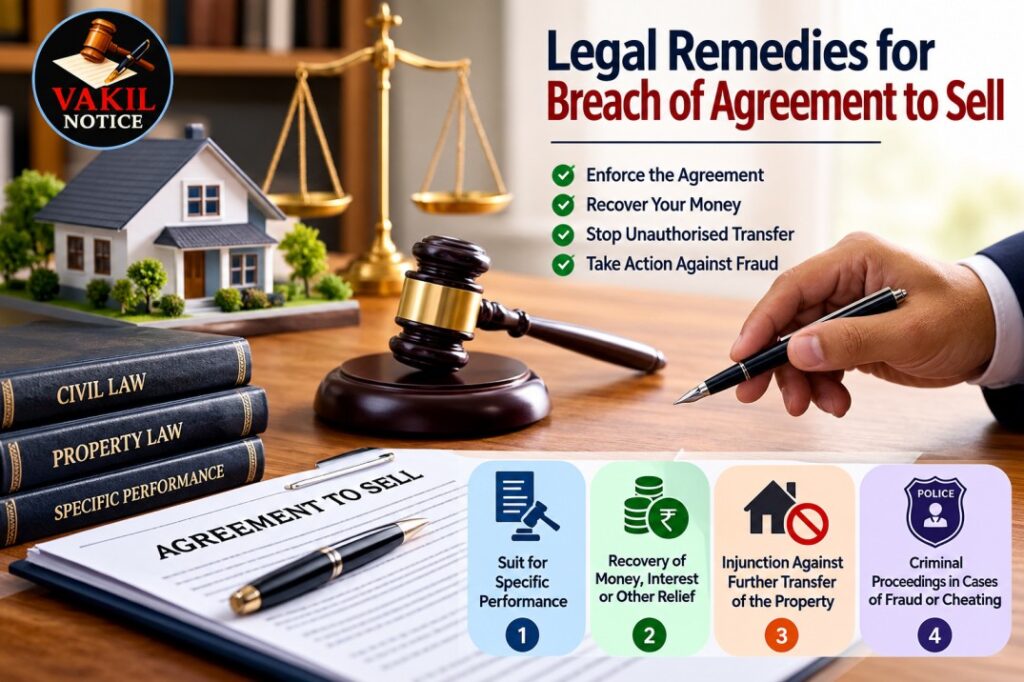
The appropriate remedy depends on the agreement and facts of the dispute.
Possible remedies may include a suit for specific performance, recovery of money and other appropriate civil reliefs.
1. Suit for Specific Performance
A buyer may seek specific performance where the legal requirements are satisfied.
The purpose of such proceedings is to seek enforcement of the contractual obligation rather than merely claiming the return of money.
Whether specific performance should be pursued depends on the agreement, evidence and applicable law.
2. Recovery of Money, Interest or Other Relief
In appropriate circumstances, a buyer may seek recovery of money paid under the agreement.
Depending on the facts and legal basis of the claim, the buyer may also seek interest or other reliefs.
3. Injunction Against Further Transfer of the Property
If there is a genuine risk that the seller may transfer or otherwise deal with the property, the buyer may consider seeking appropriate injunctive relief from the court.
The court will decide whether such relief should be granted based on the facts and applicable legal principles.
4. Criminal Proceedings in Cases Involving Fraud or Cheating
A contractual dispute does not automatically become a criminal case.
However, where the facts disclose the necessary elements of offences such as cheating or fraud, criminal proceedings may be considered separately.
A criminal complaint should not be filed merely because a contractual transaction has failed.
What If the Seller Sells the Property to a Third Party?
A seller transferring the property to another person can make the dispute more complicated.
The buyer should collect the Agreement to Sell, payment records and information about the subsequent transaction and seek legal advice without unnecessary delay.
What Legal Action Can the Buyer Take?
Depending on the circumstances, the buyer may consider appropriate civil proceedings, including specific performance and injunctive relief.
The rights of a subsequent purchaser and the effect of the later transaction depend on the facts and applicable law.
What If the Same Property Is Sold to Multiple Buyers?
Multiple agreements concerning the same property can create a serious property dispute.
The affected buyer should preserve all available documents and seek legal advice promptly to determine the appropriate civil and, where legally justified, criminal remedies.
Common Agreement to Sell Disputes and Their Legal Solutions

Agreement to Sell disputes can arise in different ways. Some of the common situations include the following.
Seller Claims That the Money Was a Loan
Sometimes a seller may later claim that the money received from the buyer was a loan rather than advance or sale consideration.
The buyer may need to rely on the Agreement to Sell, payment records, communications and other evidence to establish the actual nature of the transaction.
Seller Claims That the Buyer Was Not Ready to Pay
A seller may argue that the buyer did not have sufficient funds or was not ready to complete the transaction.
The buyer should preserve evidence showing financial capacity, payments already made and communications demonstrating willingness to complete the transaction.
Seller Keeps Delaying the Registration
Repeated postponements without completion can create a serious dispute.
In such a situation, the buyer may consider sending a legal notice, fixing a reasonable date and preserving communication and other evidence.
Seller Sells the Property to Another Person
If the seller attempts to sell or has already sold the property to another person, the buyer should seek legal advice promptly.
Depending on the circumstances, appropriate civil relief may be available.
Seller Disputes the Payment
If the seller denies receiving the advance or other payment, bank statements, receipts, transaction records and other documentary evidence can become important.
Seller Dies After Signing the Agreement
The death of the seller does not automatically determine the rights of the parties.
Depending on the circumstances, the legal heirs or representatives may need to be brought into the proceedings, subject to applicable law and the nature of the relief sought.
Property Is Mortgaged or Involved in Litigation
If the property is subject to a mortgage, litigation or another legal restriction, the buyer should investigate the property’s legal status before deciding the appropriate remedy.
Seller Has Entered Into Multiple Agreements
Multiple agreements concerning the same property can create competing claims.
In such cases, immediate legal advice is important because the documents, dates, payments and subsequent transactions may all become relevant.
Buyer Delays Taking Legal Action
A buyer who does not act after becoming aware of a serious breach may face limitation and evidentiary issues.
Timely legal advice is therefore important.
Buyer Has Possession but the Sale Deed Has Not Been Executed
Possession of the property does not by itself mean that ownership has been transferred through a registered sale deed.
The legal position depends on the documents, nature of possession and circumstances of the transaction.
What Documents Are Important in an Agreement to Sell Dispute?
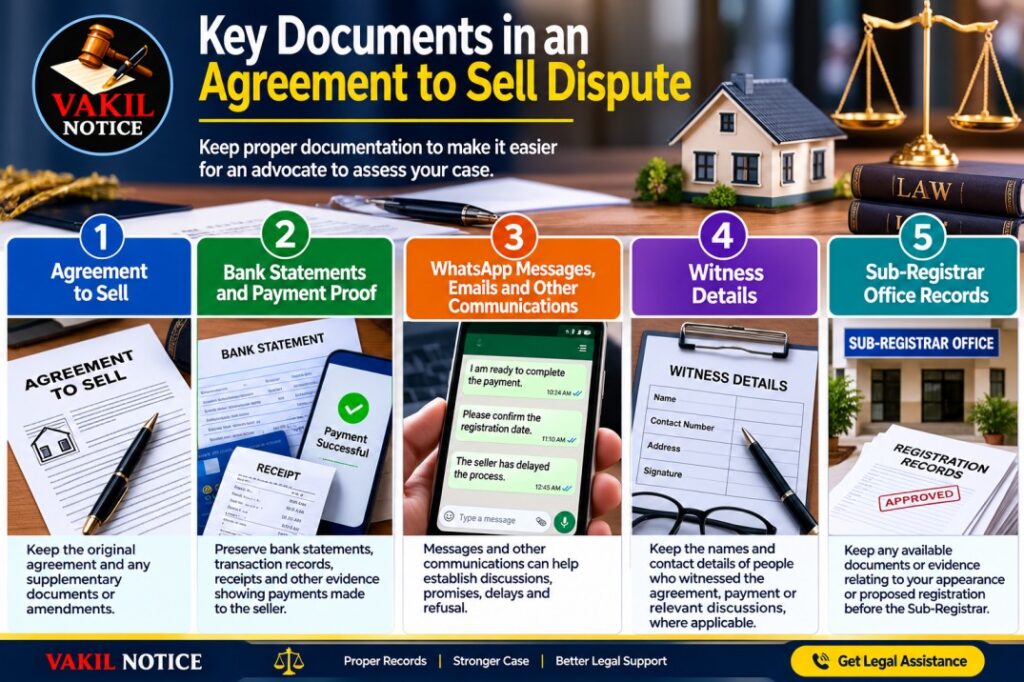
Keeping complete documentation can make it easier for an advocate to assess the dispute.
Agreement to Sell
Keep the original agreement and any supplementary documents or amendments.
Bank Statements and Payment Proof
Preserve bank statements, transaction records, receipts and other evidence showing payments made to the seller.
WhatsApp Messages, Emails and Other Communications
Messages and other communications can help establish discussions, promises, delays and refusal.
Witness Details
Keep the names and contact details of people who witnessed the agreement, payment or relevant discussions, where applicable.
Sub-Registrar Office Records
Keep any available documents or evidence relating to your appearance or proposed registration before the Sub-Registrar.
Is a Legal Notice Necessary for an Agreement to Sell Dispute?
A legal notice is not automatically mandatory in every private contractual dispute.
However, a properly drafted notice can be useful for formally communicating the buyer’s position and giving the seller an opportunity to perform the agreement.
What Should a Legal Notice for Breach of Agreement to Sell Include?
Depending on the circumstances, the notice may include:
- Details of the parties
- Date and terms of the Agreement to Sell
- Property details
- Amount paid
- Relevant payment details
- Buyer’s readiness and willingness
- Details of the seller’s breach or refusal
- A demand to perform the agreement or provide appropriate relief
- A reasonable timeline for compliance
- Consequences of non-compliance
A legal notice should be drafted according to the facts and documents of the individual case.
Agreement to Sell vs Sale Deed: What Is the Difference?
An Agreement to Sell and a registered sale deed serve different legal purposes.
An Agreement to Sell generally records the terms under which the parties agree to enter into a future sale, while a sale deed is the instrument used to transfer ownership in accordance with applicable law.
Understanding this distinction is important when dealing with a dispute over registration.
Can an Agreement to Sell Be Cancelled?
Whether an Agreement to Sell can be cancelled depends on the terms of the agreement, conduct of the parties and applicable law.
When Can a Buyer or Seller Seek Cancellation?
The appropriate remedy may depend on whether there has been a breach, whether cancellation is contractually permitted and what relief the party is seeking.
Legal advice should be obtained before signing or sending a cancellation document.
Frequently Asked Questions About Breach of Agreement to Sell
1. What can I do if the seller does not execute the sale deed?
You may consider sending a legal notice and, depending on the facts, pursuing appropriate civil remedies such as specific performance or recovery.
2. Can I file a case without waiting for three years?
The three-year period is generally a limitation period, not a mandatory waiting period. The starting point depends on the circumstances under Article 54 of the Limitation Act.
3. Is a legal notice necessary before filing a case?
A legal notice is not mandatory in every contractual dispute, but it can be useful for formally communicating your claim and recording the seller’s refusal or non-compliance.
4. What if the seller says the money was a loan?
The nature of the transaction will need to be established through the Agreement to Sell, payment records, communications and other relevant evidence.
5. What if the seller refuses to return my advance money?
Depending on the agreement and circumstances, the buyer may have a claim for recovery and other appropriate relief.
6. What if the seller sells the property to someone else?
You should seek legal advice promptly. Depending on the facts, civil remedies such as specific performance or injunction may be considered.
7. What happens if the seller dies after signing the Agreement to Sell?
The legal position depends on the circumstances. The rights and obligations may continue to involve the seller’s legal representatives, subject to applicable law.
8. What if I have possession but the registry has not been completed?
Possession alone does not necessarily establish ownership. The legal effect of possession depends on the documents and circumstances of the transaction.
9. How long does a specific performance case take in India?
There is no fixed period applicable to every case. The duration can depend on the court, evidence, pleadings, hearings, settlement efforts and other proceedings.
Related Legal Help
If you are dealing with a property dispute, you may also read our guide on:
Legal Notice for Property Disputes in India
This can help you understand when a legal notice may be useful and what information it should contain.
Need a Legal Notice for an Agreement to Sell Dispute?
If the seller has not completed the registry, is refusing to return your money, or is delaying the transaction, taking timely legal advice can help you understand your available options.
Vakil Notice can help you with legal notice drafting for property and agreement-related disputes, with advocate assistance and support through WhatsApp and email.
Get Your Legal Notice Drafted by an Advocate
Do not wait unnecessarily when the seller has clearly refused to perform the agreement.
👉 Contact Vakil Notice to discuss your matter and get assistance with drafting a legal notice.
Legal Notice Drafting | Advocate Assistance | WhatsApp & Email Support
Conclusion
A breach of an Agreement to Sell can create serious financial and legal problems, particularly when the buyer has already paid an advance amount and the seller refuses to complete the registration or return the money.
The buyer should preserve the Agreement to Sell, payment records, communications and other relevant evidence.
If the seller has refused to perform the agreement, do not assume that you have to wait for three years before taking action. The limitation period and appropriate remedy depend on the facts, the terms of the agreement and the applicable law.
Taking timely legal advice can help you understand whether specific performance, recovery, injunction or another remedy may be appropriate in your case.